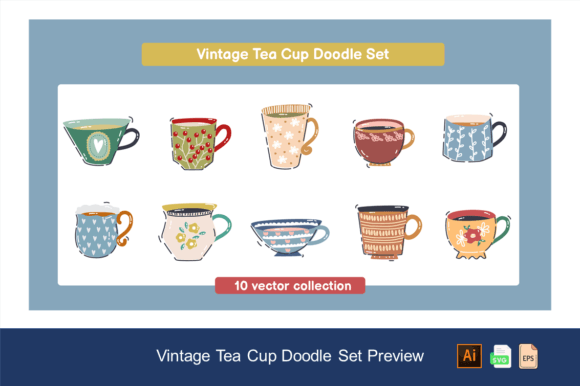
Vintage Tea Cup Doodle Set
A Designer’s First Look: Charm Without Clutter
Opening the Vintage Tea Cup Doodle Set, I immediately felt the quiet confidence of a well-considered illustration collection—not fussy, not overly sweet, but warmly nostalgic. The line work is clean and expressive, with subtle irregularities that read as hand-drawn charm rather than digital stiffness. Each cup has personality: tilted handles, steam curls with gentle asymmetry, saucers with faint scalloped edges, and tiny florals or script flourishes tucked into corners. It’s the kind of set that whispers “afternoon tea in a sunlit kitchen,” not “vintage wallpaper.” That mood matters—especially when translating to stitch.
How It Translates to Real Embroidery Projects
Last week, I prepped a custom embroidered tote bag for a local café owner who wanted something soft, feminine, and distinctly non-corporate. I chose one of the medium-sized tea cups from the Vintage Tea Cup Doodle Set—no text, just the cup and a looping steam swirl—and digitized it at 3.2" wide. On unbleached canvas with a light tear-away + cutaway combo stabilizer, it stitched cleanly: satin-stitched outlines held their shape, and the open interior areas translated beautifully into airy fill stitches. Customers noticed it right away—not because it shouted, but because it felt *intentional* and handmade.
That same cup worked equally well on a lightweight cotton apron (using reduced density and slightly larger stitch spacing) and as a standalone patch for a denim jacket. For baby onesies, I scaled down the smallest cup variant—just under 2"—and paired it with a single running-stitch steam line. No puckering, no lost detail. The vector foundation meant crisp scaling without pixelation, and the transparent PNGs made mockup creation fast and accurate.
Where It Shines—and Where to Pause
The Vintage Tea Cup Doodle Set excels in projects where subtlety supports storytelling: nursery wall art, holiday tea towel sets, boutique sweatshirt embroidery for small-batch apparel lines, personalized pillow covers for wedding gifts, or even embroidered patches for craft fair vendors. Its strength lies in versatility—not flashiness. It reads well at 2"–4" on most stable fabrics, and its moderate line weight avoids the fragility of ultra-thin doodles or the heaviness of dense illustrative motifs.
But be thoughtful with placement. On highly textured fabrics like terry cloth or bouclé, fine interior details (like tiny dots inside a cup or delicate steam wisps) may blur or disappear mid-stitch. Stretchy knits demand extra stabilizing—and consider simplifying or omitting the most intricate flourishes if stitching on curved surfaces like caps or baby hats. Dark fabric backgrounds call for higher-contrast thread choices; test your selected palette on scrap first. And while the set includes multiple arrangements, avoid stacking more than two elements tightly in a small hoop—stitch density can build up quickly in overlapping stems or loops.
What This Means for Your Craft Business
As an Etsy seller or small shop owner, the Vintage Tea Cup Doodle Set isn’t just another graphic—it’s a tone-setter. When customers see this design on your handmade product, they’re subconsciously reading consistency, care, and curation. It signals that your brand values warmth over trend-chasing, clarity over clutter. That builds trust, especially for personalized gifts or bridal shower favors where emotional resonance matters more than novelty.
I’ve used it in digital product listings too—paired with printable mockups showing the cup on linen tea towels, ceramic mugs, and kraft gift tags. Because all files are 100% vector and well organized (AI, EPS, SVG, PNG), resizing for different mockup contexts was effortless. No redrawn anchors, no broken paths. That reliability saves time when updating shop banners or bundling assets for wholesale partners.
Practical Notes Every Embroidery Designer Should Keep Handy
- Always test on scrap fabric first—especially if using textured, dark, or stretchy materials.
- Review stitch density before finalizing. Some versions include delicate interior linework that benefits from slight simplification for tighter fills.
- Confirm hoop size compatibility. While the vector files scale freely, your machine’s maximum hoop area determines how much of a multi-cup layout you can embroider in one go.
- Inspect small details at actual stitch size. A 1.5mm loop in Illustrator might become a barely-there 2-ply satin stitch—adjust accordingly.
- Test black-and-white mockups to assess contrast and legibility before committing to thread colors.
- Compare performance on light vs. dark fabric—some flourishes gain presence on charcoal linen but fade on ivory twill.
- Use appropriate stabilizer: light cutaway for knits, tear-away for stable wovens, and fusible + tear-away for lightweight silks or rayons.
- Verify licensing terms before selling finished embroidered items or bundling the files into digital products—this set is labeled for commercial use, but always double-check scope (e.g., physical goods vs. resale of editable files).
Final Thought: Design That Supports, Not Overpowers
The Vintage Tea Cup Doodle Set doesn’t try to be everything. It’s not a maximalist border, a bold monogram, or a photorealistic scene. It’s a quiet, confident accent—a design asset that elevates rather than competes. Whether you’re stitching a single cup onto a child’s tea set napkin or building a full holiday collection around the motif, it holds space for craftsmanship, not chaos. That’s rare. And for designers, makers, and small business owners who value intention over impulse, it’s exactly the kind of Illustrations set worth keeping on speed-dial.